Hidden Pairs vs Naked Pairs: How to Spot the Difference
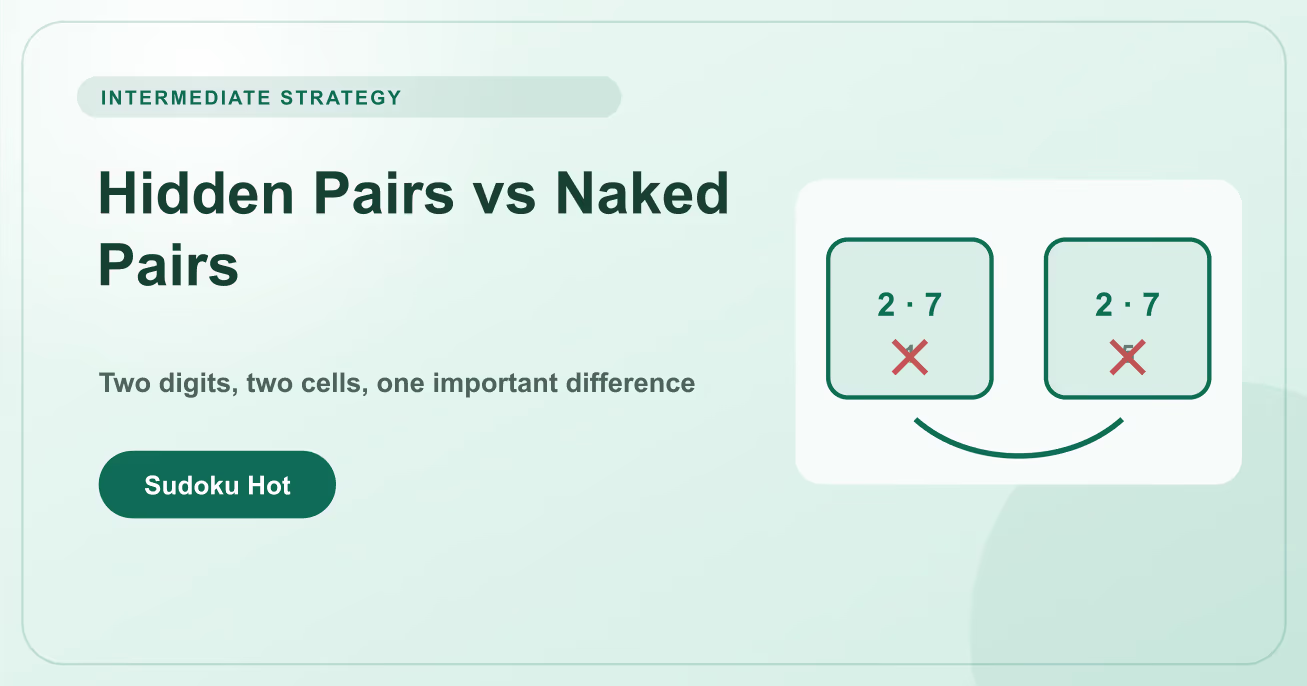
Naked Pairs are easy to recognize because two cells openly show the same two candidates. Hidden Pairs reverse the perspective: two digits appear in only the same two cells of a row, column, or box, even though those cells may contain several extra notes. The pair is hidden among the clutter. Once found, every other candidate can be erased from those two cells. Learning the contrast prevents a common plateau where a solver understands pairs in theory but scans the wrong part of the candidate grid.
A naked pair is defined by two cells; a hidden pair is defined by two digits and their only two homes.
What makes a pair hidden?
A Hidden Pair exists in one house—a row, column, or 3×3 box—when two digits can appear in exactly the same two cells and nowhere else in that house. Suppose digits 2 and 7 occur only in r4c3 and r4c8, while those cells currently read {1,2,7} and {2,5,7}. Because row 4 must contain both 2 and 7, those two cells are reserved for the pair. Candidates 1 and 5 can be removed from the pair cells. A Naked Pair performs the opposite-looking cleanup: two cells already contain only {2,7}, so 2 and 7 can be removed from other cells in the house.
How to spot Hidden Pairs reliably
- Work in one house at a time. Pick a row, column, or box with complete, current candidate notes. Hidden pairs are a house-level pattern, so mixing cells from different units cannot prove anything.
- Count positions by digit. Instead of searching for two-candidate cells, ask where each missing digit can go. Circle digits that appear in exactly two cells in the house.
- Compare the two-cell locations. If two different digits share the same exact pair of cells, they form a Hidden Pair. The cells may contain extra candidates before cleanup.
- Remove extras from the pair cells. Keep only the two hidden digits in those cells. Do not remove the pair digits from other houses unless a separate rule justifies it.
- Re-evaluate intersecting units. Cleaning the pair may create a Naked Pair in a crossing box or expose a Hidden Single elsewhere. Update candidates before starting another search.
Worked example: hidden {2,7} in row 4
Assume row 4 is missing digits 1, 2, 5, 7, and 9. Candidate 2 appears only in r4c3 and r4c8. Candidate 7 also appears only in r4c3 and r4c8. Other digits still have positions elsewhere in the row. That repeated location pattern reserves the two cells for 2 and 7.
- Record the position map. For digit 2, write c3/c8. For digit 7, write c3/c8. The identical map is the proof; it is more important than how many notes currently appear inside either cell.
- Clean the first cell. If r4c3 is {1,2,7}, remove 1. Row 4 must place 2 and 7 across the two reserved cells, leaving no room for 1 in r4c3.
- Clean the second cell. If r4c8 is {2,5,7}, remove 5. Both cells now show {2,7}, turning the hidden relationship into a visible Naked Pair.
- Use the new visibility carefully. Because the two pair cells share row 4, remove 2 and 7 from any other row-4 notes that remain due to stale notation. If they also share a box, the pair acts in that box too.
Common Hidden Pair mistakes
Looking only at short candidate lists
A hidden pair can sit inside cells with three, four, or more notes. Search by the positions of digits, not only by cells that already look tidy.
Accepting a third location
If either digit can appear in a third cell of the house, the two chosen cells are not reserved. Recheck every unsolved cell before removing extra candidates.
Deleting outside the pair cells first
A Hidden Pair directly removes other candidates from the two pair cells. It does not by itself erase the pair digits elsewhere; their exclusivity should already be true in the source house.
Hidden Pair practice checklist
- Use complete candidate notes in one busy row, column, or box before searching for hidden subsets.
- List each missing digit and the columns or rows where it can appear; compare digits with exactly two locations.
- Before cleanup, verify that both digits share the same two cells and neither has a third location.
- After cleanup, scan the two crossing houses for singles, Locked Candidates, or a newly visible Naked Pair.
To train Hidden Pairs, stop asking “which cells have two notes?” and start asking “where can this digit still go?” That small change of viewpoint separates hidden from naked subsets. Use a Hard Classic grid with complete candidates, inspect one crowded house at a time, and write down two-position maps until the matching locations become visually obvious.
Hidden Pairs FAQ
Can a Hidden Pair cell contain more than three candidates?
Yes. Extra notes do not invalidate the pattern. If the two target digits have no other positions in the house, every other candidate in those two cells can be removed.
Why not just wait until the pair becomes naked?
Sometimes another deduction will expose it, but harder puzzles may require the hidden-pair cleanup to create that deduction. Finding it now can unlock stalled candidate chains.
Do Hidden Pairs solve either cell immediately?
Usually not. They reduce both cells to two candidates. Their value is the cleanup and the consequences it creates in crossing rows, columns, or boxes.
Can two cells form a pair in both a row and a box?
Yes, when both cells share both units. The same two final candidates then interact with each unit, although each elimination must still follow from a valid house-level relationship.
Are Hidden Triples found the same way?
Yes in principle: three digits restricted to the same three cells form a Hidden Triple. The larger position combinations are harder to see, so pairs are the best training ground.