X-Wing Explained Simply: An Advanced Sudoku Pattern

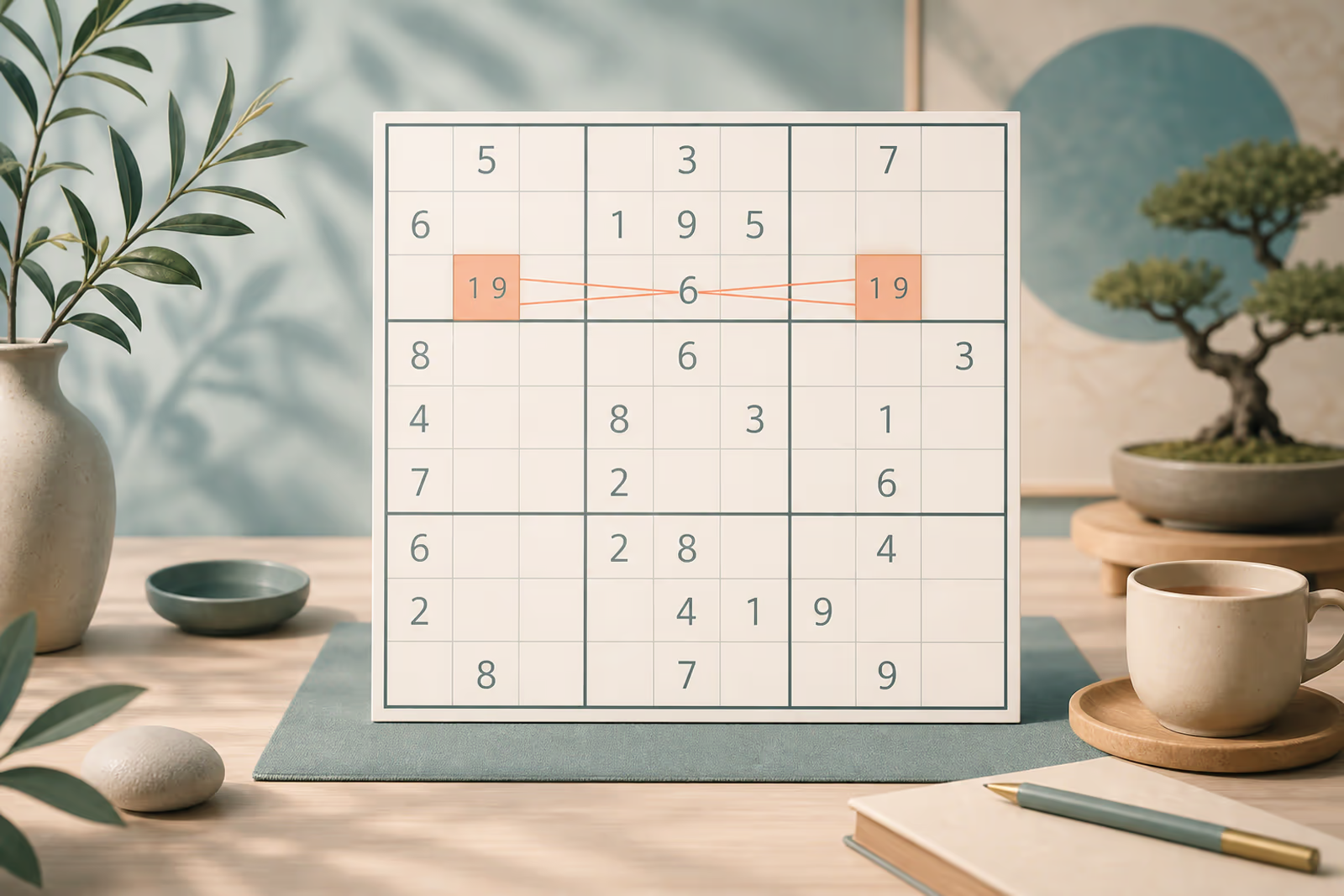
When singles and pairs stop moving the board, advanced patterns take over. The X-Wing is one of the cleanest: a single digit locked into two rows and two columns forms a rectangle. Once you see the rectangle, you can eliminate that digit from the rest of those columns (or rows). No guessing — just geometry.
If the candidates draw a rectangle, the eliminations write themselves.
What is an X-Wing?
An X-Wing appears when a digit (say 7) can appear in only two cells of row A, and those same two columns are the only places 7 can appear in row B. The four cells sit at the corners of a rectangle. Because each of those rows must place a 7 in one of those two columns, both columns are "spoken for." Therefore any other 7-candidate in those two columns outside the rectangle can be erased. The same pattern works with columns as the base and rows as the fish fins.
How to spot and apply an X-Wing
- Pick a digit that is almost locked. Focus on a number with few remaining placements. Crowded digits hide patterns; sparse digits reveal them.
- Scan for two rows with the same two columns. In candidate notation, look for a digit that marks exactly two cells in a row, then find a second row with the same pair of columns.
- Confirm the rectangle. The four cells must align. If a third column sneaks into either row, it is not an X-Wing yet.
- Eliminate outside the corners. Remove the digit from all other cells in those two columns (or two rows, if you started from columns). Then look for new singles created by the cleanup.
Example: a row-based X-Wing on 7
Suppose digit 7 appears as a candidate exactly twice in row 2: r2c3 and r2c8. Row 7 also has exactly two candidates for 7, in the same columns: r7c3 and r7c8. Those four corners form the X-Wing.
- Verify both base rows. Rows 2 and 7 must each contain exactly two candidates for 7, and the candidates must align in columns 3 and 8. A third 7 in either row breaks the pattern.
- State the two possible arrangements. If row 2 places 7 in column 3, row 7 must place it in column 8; or the arrangement reverses. Either way, columns 3 and 8 receive their 7 at the four corners.
- Eliminate outside the corners. Remove candidate 7 from every other cell in columns 3 and 8. Keep all four corner candidates until another rule decides which diagonal is correct.
Common X-Wing mistakes
Accepting an extra base candidate
For a row-based X-Wing, each base row must have exactly two positions for the digit. If one row has a third position, the digit is not locked to the rectangle.
Erasing the four corners
The corners are the positions that support the pattern. Eliminate the digit only from other cells in the cover columns, not from the X-Wing itself.
Mixing candidate digits
All four corners must refer to the same digit. A rectangle made from different candidate pairs is not an X-Wing.
An X-Wing practice checklist
- Choose one digit with relatively few candidates and count its positions row by row.
- Mark rows with exactly two positions, then compare their column numbers.
- Before eliminating, say the two possible corner arrangements and identify the cover columns.
Practice X-Wings on Hard and Expert Classic grids, then carry the same rectangular thinking into Hell Mode cages when candidates line up across boxes. Pattern recognition is a skill — and Sudoku Hot's difficulty ladder is built to train it.
Questions about X-Wing
Can an X-Wing start from columns instead of rows?
Yes. Two columns can each contain the digit in the same two rows. In that orientation, you eliminate the digit from other cells in the two cover rows.
Do the four corners need to be in different 3×3 boxes?
No. Alignment in two rows and two columns is what matters. Box placement may create additional eliminations, but it is not the defining condition.
Why is my X-Wing not producing a solved cell?
An X-Wing guarantees candidate eliminations, not an immediate placement. Its value is often revealed one or two logical steps later when a removed candidate creates a single.