10 Common Sudoku Mistakes and How to Recover
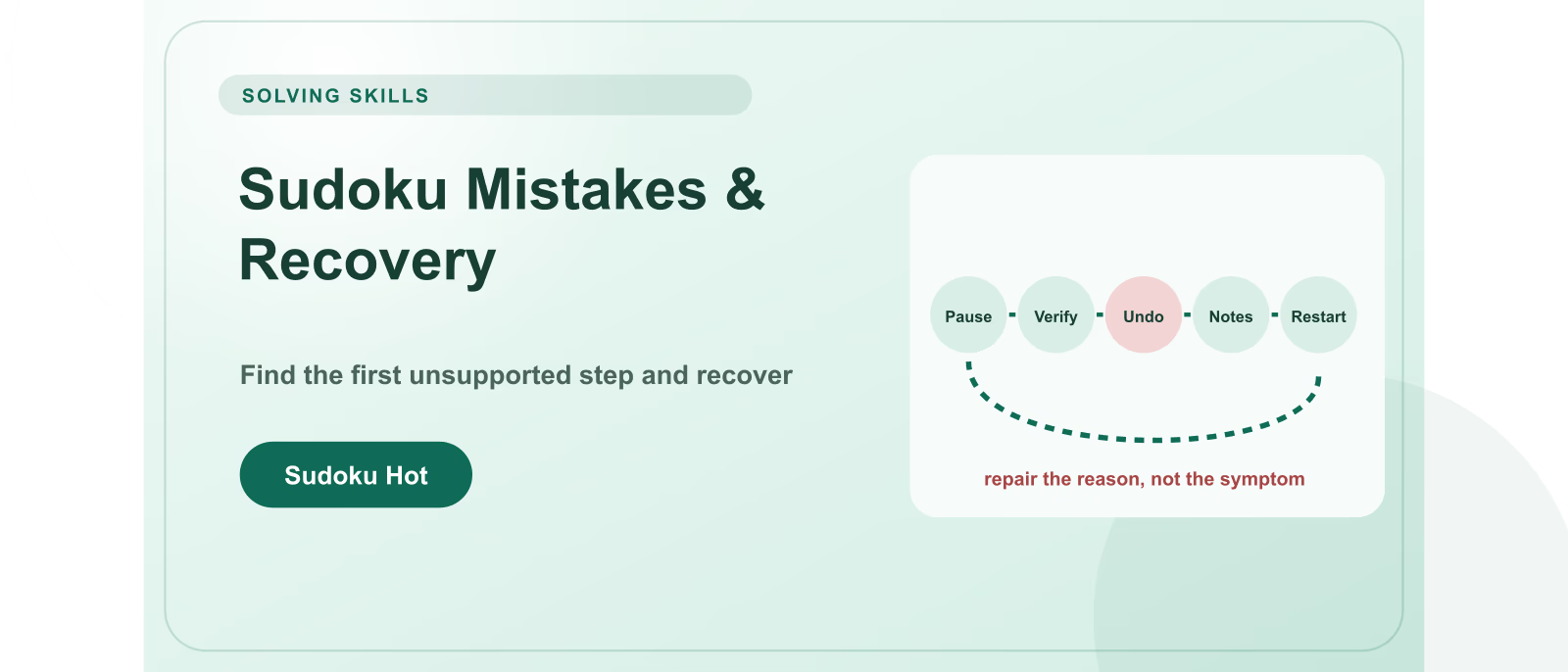
Most Sudoku errors are not failures of intelligence or missing advanced knowledge. They come from repeatable habits: placing a plausible digit without proof, forgetting to update notes, applying a valid pattern outside its region, or staring at one corner until the rest of the board disappears. The good news is that these mistakes are recoverable. A structured audit can locate the first unsupported step and restore the solve without throwing away every correct deduction.
Do not repair the last contradiction; repair the first step that lacked a reason.
The 10 mistakes that cause most trouble
The most common problems are: guessing between two candidates; missing a row, column, or box conflict; leaving stale notes; confusing Naked and Hidden Singles; using two matching candidates that do not share a house; eliminating beyond the house that proves a pair; overlooking a third candidate in a Locked Candidate pattern; treating a cage combination as ordered; continuing an advanced search after a new single appears; and developing tunnel vision around one cell. They share one cause: the solver stops verifying the relationship between a change and the exact rule that supports it.
How to recover from a wrong or stalled board
- Pause before adding another digit. More moves make the source harder to find. Stop at the first duplicate, impossible cell, or point where every candidate seems blocked.
- Check direct conflicts first. Inspect the affected row, column, and box for duplicates. Then verify that each placed digit was absent from all three units at placement time.
- Audit the most recent deduction. Name its rule and source house. If you cannot explain why the placement or elimination was forced, undo it and restore the prior candidates.
- Rebuild notes locally. Recalculate candidates in the affected units from placed digits instead of trusting the current marks. Expand to the whole board only if the local audit fails.
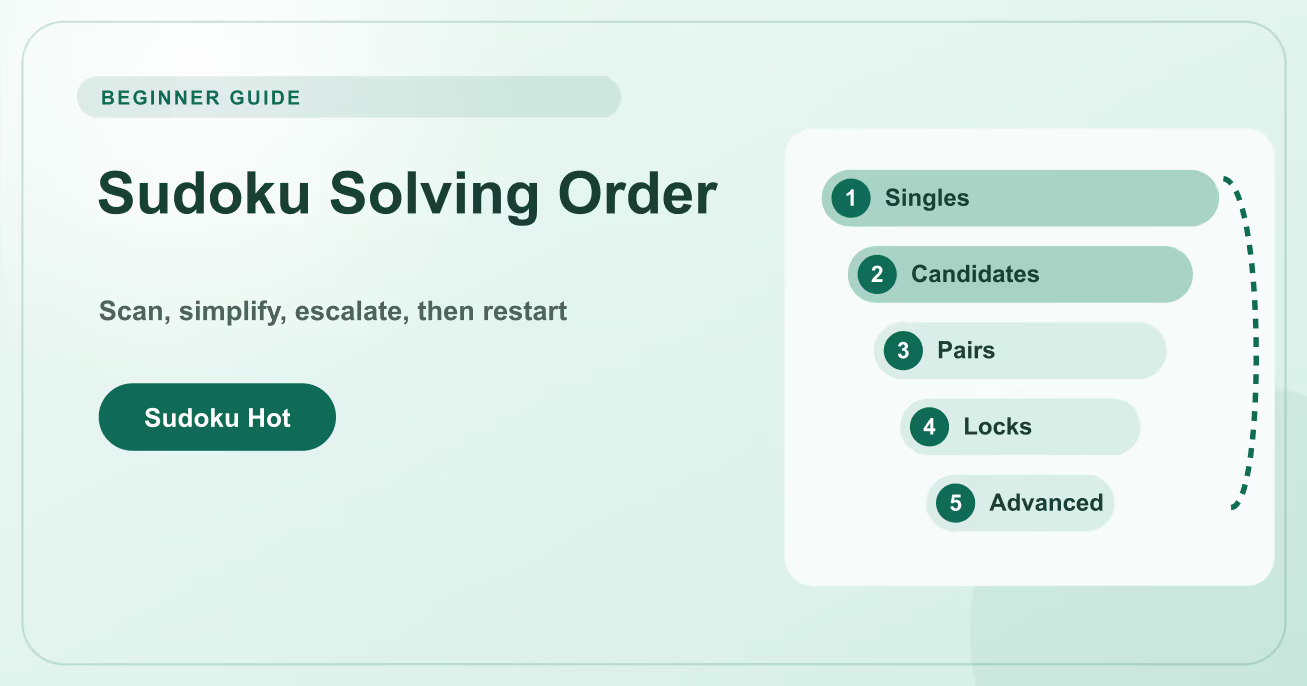
- Restart the solving order. Once the board is consistent, scan for singles before returning to pairs, locks, or advanced patterns. The repair itself may have exposed an easy move.
Worked example: recovering from an invalid pair elimination
Suppose you removed candidate 6 from row 7 after seeing {2,6} in r7c2 and {2,6,9} in r7c8. Later the row has no legal place for 6. The contradiction points back to a pair that was never valid.
- Identify the unsupported claim. A Naked Pair requires both cells to contain exactly the same two candidates. The extra 9 in r7c8 means the two cells did not reserve {2,6}.
- Restore the deleted candidates. Put candidate 6 back into the other row-7 cells from which it was removed, then test each restored note against column and box constraints.
- Recalculate the two source cells. Verify {2,6} and {2,6,9} from scratch. Another rule may legitimately remove 9 later, but the pair cannot be assumed before that happens.
- Resume from singles. With the row consistent again, scan it and its crossing boxes. A Hidden Single may determine 9 and eventually create the real pair safely.
Three habits that prevent repeat errors
State the reason before the move
A short sentence—“only cell for 4 in this box” or “pair removes 7 in this row”—exposes vague reasoning before it changes the board.
Separate notes from answers
Keep Notes mode visually distinct from final placements. A possibility should never become a large digit because of a mode mistake.
Use Undo as an audit tool
Undo is not failure. Step back to the first move you cannot justify, correct the candidate state, and replay only deductions that remain valid.
Mistake-prevention checklist
- Before placing, check the row, column, and box and name the technique that forces the value.
- Before a pair or lock elimination, confirm every candidate position in the source house.
- After progress, update notes and restart at singles rather than continuing a difficult pattern search.
- When stuck, switch units or candidate digits and inspect the whole board before assuming no move exists.
Accuracy improves fastest when errors become evidence. After a wrong move, record whether the cause was stale notes, an invalid region, a hidden third candidate, or an unsupported guess. A few such audits will reveal a personal pattern—and fixing that habit will improve every difficulty more than memorizing one extra advanced technique. During the next puzzle, slow down only at that failure point and keep the rest of your natural solving rhythm.
Sudoku mistakes FAQ
Should I restart after placing a wrong digit?
Usually not. Undo to the first unsupported move, rebuild candidates in the affected units, and verify that the rest of the board remains consistent.
Why does a puzzle sometimes look impossible after several correct moves?
One earlier candidate deletion may have been invalid even if the placed digits look legal. Audit eliminations as well as final values.
Is using Undo cheating?
No. Used deliberately, Undo reveals which reasoning step failed. Repeatedly testing both branches without learning the rule is less useful.
How do I avoid tunnel vision?
Set a scan cycle: boxes, rows, columns, then one candidate digit. If a pass produces nothing, change technique instead of staring at the same cell.
What if I cannot explain a hint?
Do not just copy the value. Compare its row, column, box, and candidates until you can name the technique, then look for a similar pattern elsewhere.