Sudoku Solving Order: A Beginner Checklist That Works
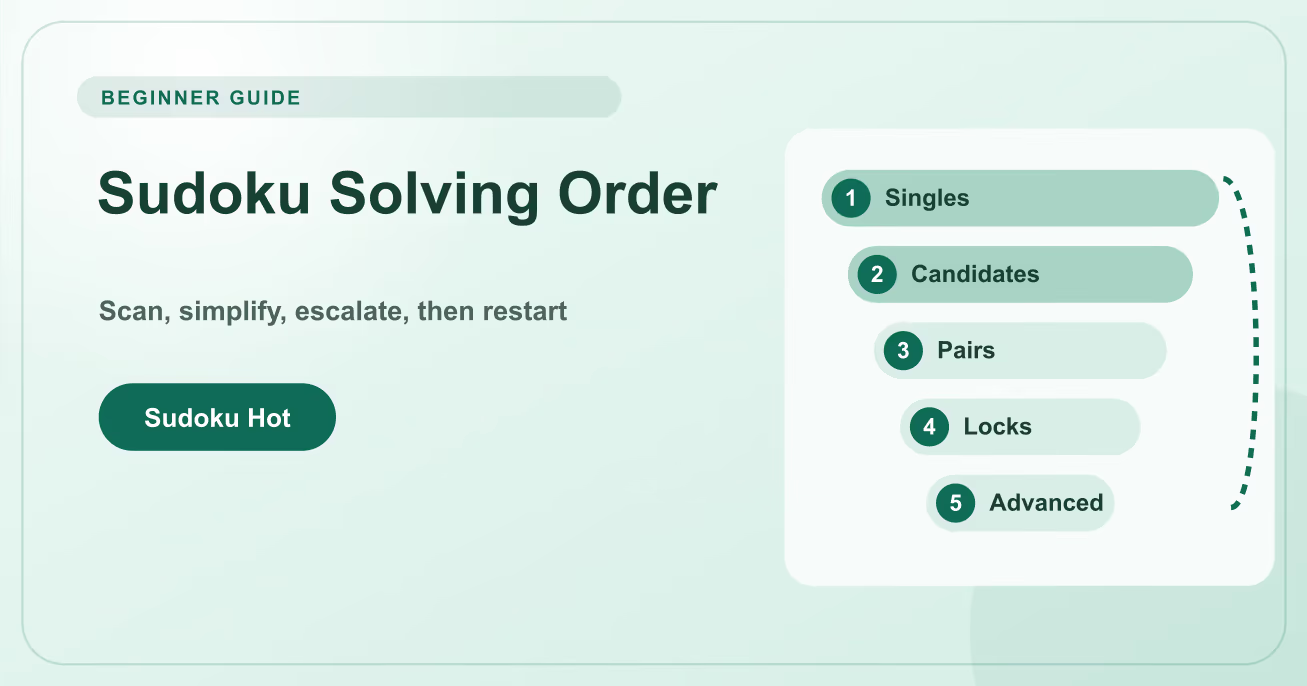
Many Sudoku stalls are not caused by a missing advanced technique. The solver simply stops scanning in a consistent order and overlooks a single created by the previous move. A solving order is a repeatable checklist: take the cheapest information first, update the board, and climb to a harder technique only when the easier layers are genuinely exhausted. It reduces random searching, keeps candidate notes trustworthy, and makes it clear what to practice next.
The best next technique is usually the simplest one you have not checked again.
Why technique order matters
Sudoku techniques form a practical ladder. Singles place digits directly. Pairs and Locked Candidates remove possibilities. More advanced patterns compare candidates across several houses and often produce only one elimination. Because every elimination can create a new single, continuing to hunt advanced patterns wastes effort and increases error risk. A good order is therefore cyclical rather than one-way: scan, place, update, return to the beginning, and move upward only after a complete pass produces nothing.
The solving order from start to finish
- Scan givens and crowded units. Cross-hatch digits through boxes, then inspect rows and columns with few empty cells. Take all visible Naked and Hidden Singles.
- Add and update candidates. When scanning stalls, create accurate notes for the area you are studying. Re-run the single scan because candidate lists often reveal what eyesight missed.
- Search subsets. Check Naked Pairs first, then Hidden Pairs and triples when needed. Apply eliminations only inside the row, column, or box that proves the subset.
- Check box-line interactions. Look for pointing and claiming Locked Candidates. These patterns bridge one box with one row or column and frequently unlock Hard puzzles.
- Escalate, then restart. Use X-Wing or another advanced method only after the lower layers fail. After any elimination or placement, return immediately to singles and begin the cycle again.
Worked example: one cycle through a stalled board
You finish an initial scan and see no placements. Rather than jumping straight to X-Wing, complete candidates in the most crowded unsolved box. Two cells reveal {4,9}, forming a Naked Pair and removing 4 from another cell. That cell becomes a single, and the resulting placement creates two more Hidden Singles.
- Finish the simple scan. Check digits 1 through 9 across boxes, rows, and columns. A full pass prevents an overlooked Hidden Single from being buried under later notation.
- Use the first available subset. In the middle-right box, r4c8 and r6c8 both contain only {4,9}. Remove 4 and 9 from the other unsolved cells of that box.
- Take the immediate single. If r5c9 changes from {4,7} to {7}, place 7. Do not continue searching for pairs before propagating this confirmed digit.
- Restart from the bottom rung. Update row 5, column 9, and the box, then scan for singles again. The pair did its job; the easiest techniques now carry the solve forward.
Common solving-order mistakes
Searching for favorite patterns first
Knowing X-Wing can make every grid look like an X-Wing hunt. Advanced searches are slower and less reliable than collecting available singles and pairs.
Failing to restart after progress
Every placement changes three houses. Continuing at the same technique level can skip the simple deductions that the move just created.
Mixing candidate updates with assumptions
The checklist works only when notes reflect proven constraints. Do not “temporarily” remove candidates to make a pattern easier to see.
Beginner solving checklist
- Singles: scan boxes, rows, and columns digit by digit; then inspect cells with one remaining candidate.
- Notes: update the peers of every placement before searching for a new technique.
- Subsets and locks: try Naked Pairs, Hidden Pairs, then Locked Candidates one house at a time.
- Advanced: use X-Wing or harder patterns only after a complete lower-level pass; restart at singles after any progress.
Print the checklist mentally into every solve: scan, note, pair, lock, escalate, restart. The order is not a rigid law—some boards invite a clear pattern early—but it gives beginners a safe default and experienced solvers a reset when attention becomes scattered. Practice it on one comfortable Classic level until you can name the current rung without thinking. Keep a short record of the rung that unlocked each puzzle; after several games, it will show which technique deserves your next focused practice session.
Sudoku solving order FAQ
Should I scan rows, columns, or boxes first?
Boxes are often easiest for cross-hatching, but no universal starting unit is mandatory. Choose crowded units and use the same sequence consistently enough that none are skipped.
When should I start using pencil marks?
After direct scanning stops producing singles. On Easy grids, selective notes may be enough; on Hard and above, complete and current candidates support reliable pattern searches.
Do I need to know every advanced technique?
No. Build a dependable core—singles, pairs, Locked Candidates, and one fish pattern—then add techniques when your chosen difficulty regularly requires them.
How long should one technique scan take?
Long enough to complete a deliberate pass, not indefinitely. If a scan produces nothing, switch unit, candidate digit, or technique instead of staring at the same cells.
Why do singles appear after an advanced elimination?
Advanced techniques remove candidates. A cell or digit position that had two possibilities may drop to one, creating a Naked or Hidden Single that should be taken immediately.