Finding Hidden Singles in Sudoku: Beginner Strategy

Welcome to practical sudoku logic. If you sometimes stare at the grid hoping the next move appears, foundational strategies will help. Today we focus on the Hidden Single—one of the most essential techniques for beginners.
Logic is the soul of Sudoku. Let the grid guide your mind.
What is a Hidden Single?
A Hidden Single occurs when a specific digit can only go in one cell within a 3×3 block, row, or column—even if that cell could hold other candidates on paper. It is "hidden" because you discover it by tracing how the same digit elsewhere on the board eliminates other cells.
How to spot them
- Focus on a specific digit. Pick a number that already appears often on the board (for example, 5).
- Scan a 3×3 block. Look at a block that does not yet contain your chosen digit.
- Trace the lines. If a 5 exists in a row crossing the block, no cell in that row inside the block can be 5.
- Find the remaining cell. Eliminate cells shaded by other 5s in crossing rows and columns. If only one cell remains, you found a Hidden Single.
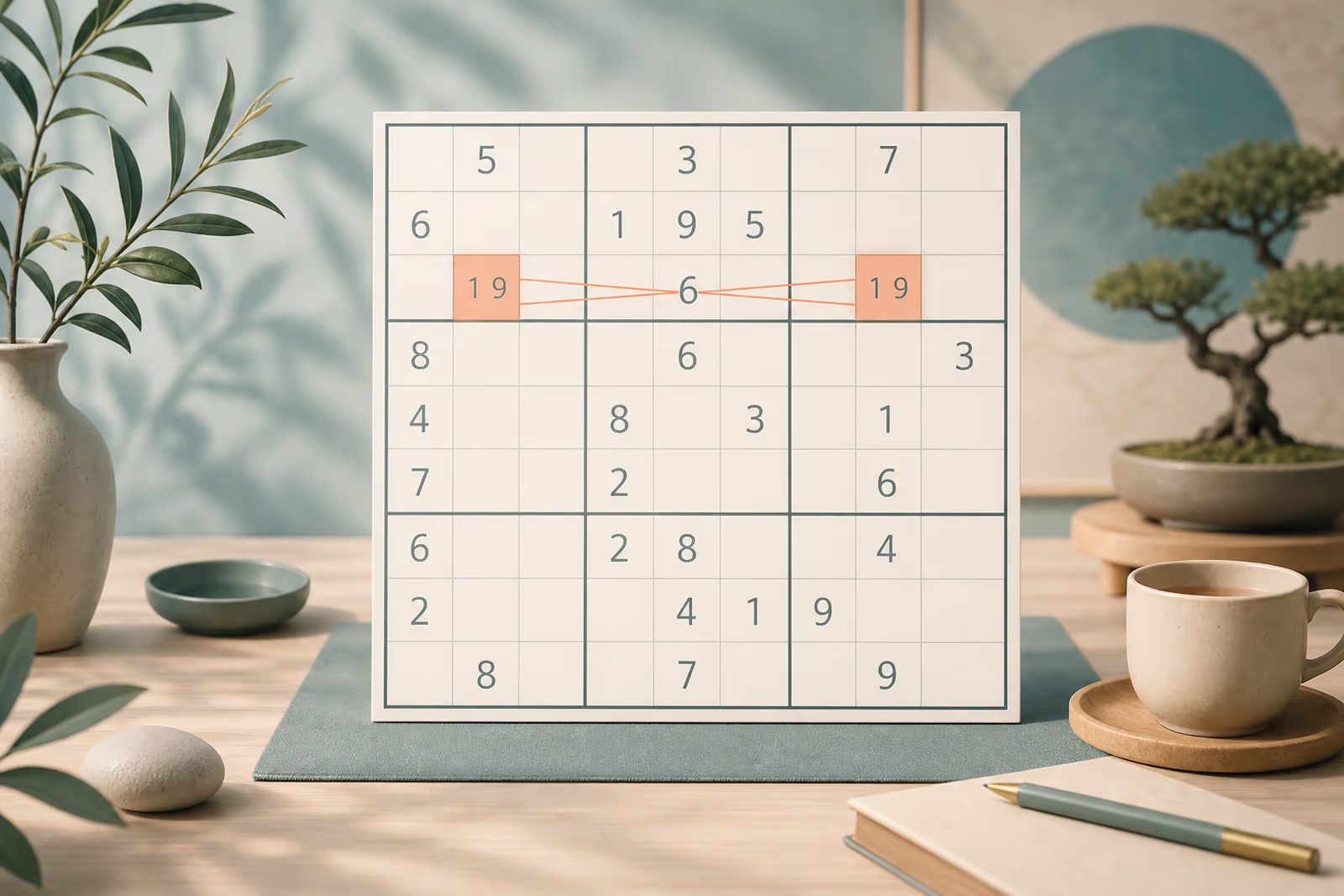
Diagram: tracing lines to find a Hidden Single 5 in the center block.
Example: finding a hidden 5 in the center box
Imagine the center 3×3 box has no 5. Row 4 already contains a 5 outside the box, so all three cells where row 4 crosses the box are excluded. Row 5 also contains a 5, removing its three center-box cells. Three cells remain in row 6, and column clues will decide between them.
- Mark the open cells in the unit. After the row eliminations, the only possible center-box locations for 5 are r6c4, r6c5, and r6c6.
- Use the crossing columns. A 5 already in column 4 eliminates r6c4, and a 5 in column 6 eliminates r6c6. That leaves r6c5 as the only legal location.
- Place the digit and rescan. Write 5 in r6c5, then check row 6, column 5, and the center box again. One hidden single often creates a naked single nearby.
Common hidden-single mistakes
Confusing hidden and naked singles
A naked single has only one candidate in the cell. A hidden single can share its cell with other notes; it is unique only within its row, column, or box.
Scanning every digit at once
Choose one digit and follow it through several units. Switching numbers constantly makes the crossing lines harder to remember.
Checking only the 3×3 boxes
Hidden singles also occur in rows and columns. After scanning boxes, repeat the same digit-by-digit search across the long lines.
A focused practice checklist
- On an Easy grid, choose one digit and scan all nine boxes before switching digits.
- Say the reason before placing: “This is the only cell for 5 in this box.”
- After every placement, rescan the affected row, column, and box for the next single.
Practicing this technique improves solve times and prepares you for Medium and Hard puzzles. Take a breath, scan the whole board, and let the pattern emerge.
Hidden singles FAQ
Do I need pencil marks to find hidden singles?
No. Cross-hatching one digit through rows and columns is often enough on Easy puzzles. Notes become more useful when several digits remain possible in each cell.
Can a hidden single have several candidates written in its cell?
Yes. The cell may show multiple candidates, but only one of those digits has no other legal position in the same row, column, or box.
Where should beginners scan first?
Start with boxes, rows, or columns that are already crowded, and with digits that appear many times. Fewer empty positions mean fewer places to test.