Killer Sudoku Cage Combinations & the 45 Rule
Killer Sudoku swaps most given digits for cages — dotted regions that must add up to a printed sum, with no repeated digit inside. Fast solvers rarely add cell by cell. Instead they memorize a short list of cage combinations and let arithmetic do the eliminating. Here is that list, plus the 45 rule that ties it all together.
Every row, column, and box sums to 45. Killer Sudoku is arithmetic wearing a logic mask.
What are cage combinations?
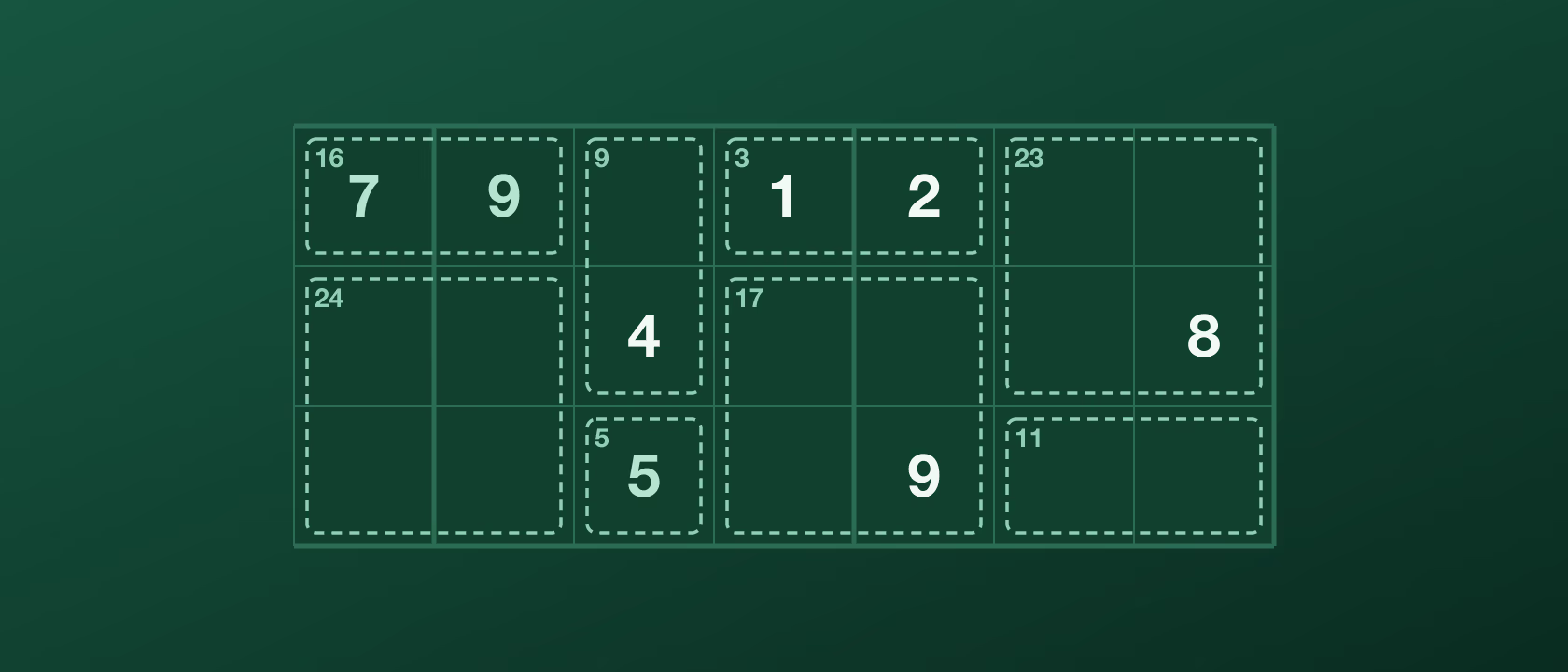
A cage combination is the set of digits that can legally fill a cage. A two-cell cage summing to 3 can only be 1+2; a sum of 17 can only be 8+9. A 16 cage in two cells must be 7+9, because 8+8 would repeat a digit. Extreme sums — the smallest and largest possible for a cage size — allow the fewest combinations, so they are always your best entry points: two cells with 3, 4, 16, or 17; three cells with 6, 7, 23, or 24.
How to crack cages with the 45 rule
- Pencil in the unique cages first. Cages with only one possible digit set (like a two-cell 17 or a three-cell 24) hand you candidates for free. Mark them before anything else.
- Apply the 45 rule. Every row, column, and 3×3 box sums to 45. If cages exactly cover a box except for one cell, subtract their sums from 45 — the remainder is that cell’s value.
- Cross-check with classic rules. Cage candidates still obey row, column, and box constraints. A 7+9 cage crossing a column that already contains a 9 collapses to a single arrangement.
- Recalculate big cages as digits land. Once one cell of a large cage is fixed, subtract it from the target and treat the rest as a smaller cage — its combination list shrinks every time.
Diagram: a two-cell 16 cage can only hold 7 and 9.
Example: finishing a box with the 45 rule
Suppose cages fully contained in one 3×3 box cover eight cells and their clues total 42. Because every Sudoku box contains the digits 1 through 9 exactly once, the completed box must total 45. The uncovered cell is therefore 45 − 42 = 3.
- Confirm the boundary. Count every cage cell. Use the subtraction only when the included cage sums account for all cells except the target, or when you have explicitly included every cell crossing the boundary.
- Subtract from 45. The known cage total is 42, so the missing value is 3. Write 3 only after checking that its row and column can legally accept it.
- Reduce the neighboring cages. Placing 3 may fix an entry in a crossing cage. Subtract the placed value from that cage clue and rebuild the smaller combination list.
Common Killer Sudoku mistakes
Allowing a repeated digit in a cage
A two-cell cage totaling 16 cannot be 8+8. Cage combinations use distinct digits even when the cells sit in different rows or boxes.
Treating a combination as an order
A {7,9} cage tells you which digits are present, not which cell gets each digit. Row, column, and box constraints determine the order.
Using 45 across an incomplete region
Cages that cross a box boundary must be handled explicitly. Ignoring the outside cells produces a confident-looking but incorrect subtraction.
A focused practice checklist
- Memorize the extreme two-cell sums first: 3, 4, 16, and 17.
- Circle rows, columns, or boxes whose cage boundaries are almost complete, then test the 45 rule.
- After placing a digit, update both its classic Sudoku peers and the remaining sum of its cage.
Drill these combinations until they feel like reflexes, then put them under pressure: Hell Mode on Sudoku Hot is full Killer Sudoku across five tiers, and the daily challenge rotates cage layouts so the arithmetic never goes stale.
Killer cage combinations FAQ
Do I need to memorize every cage combination?
No. Begin with the smallest and largest sums because they have the fewest options. You can derive middle sums as needed and will remember them naturally through repetition.
Why does every row, column, and box total 45?
Each contains the digits 1 through 9 exactly once, and 1+2+3+4+5+6+7+8+9 equals 45.
Can a cage cross a 3×3 box boundary?
Yes. Its sum and no-repeat rule still apply, while every cell also obeys its own row, column, and 3×3 box constraints.