Killer Sudoku Strategy for Beginners: Cages, Sums & First Moves
Killer Sudoku combines classic row, column, and box rules with dotted cages whose cells must add to a target. The extra arithmetic can make a nearly blank board look hostile, but the opening is systematic. Strong first moves come from cages with very few combinations, regions that nearly total 45, and intersections where a cage candidate conflicts with a placed digit. The goal is not rapid mental addition; it is to make the cage and classic constraints reduce each other.
A cage gives the sum; the row, column, and box decide the order.
What should a beginner solve first?
Begin with extreme cages: small sums such as a two-cell 3 or large sums such as a two-cell 17 have only one digit combination, {1,2} and {8,9}. Three-cell totals 6 and 24 are similarly restricted. Then look for complete or nearly complete rows, columns, and boxes. Every classic house contains digits 1–9 and therefore totals 45. If contained cage sums account for eight cells of a box, subtracting from 45 determines the ninth. Throughout the solve, cage digits cannot repeat, and every candidate must still obey its row, column, and box.
A beginner Killer Sudoku solving order
- Mark unique cage combinations. Start with two-cell sums 3, 4, 16, and 17 and three-cell sums near 6 or 24. Record digit sets without assuming their order.
- Use classic constraints to order cages. If a {7,9} cage crosses a row that already contains 9, the cell in that row must be 7 and the other cell becomes 9.
- Find safe 45-rule regions. Add cage totals fully contained in one row, column, or box. Subtract from 45 only after accounting for every cell and every cage that crosses the boundary.
- Reduce cages after each placement. Subtract solved digits from the cage target and rebuild the remaining combination using distinct digits. A four-cell cage can quickly become a simple pair.
- Alternate arithmetic and Sudoku scans. After cage progress, look for singles in rows, columns, and boxes. After classic progress, revisit every touched cage for a smaller remaining sum.
Worked example: solving a 16 cage with a row clue
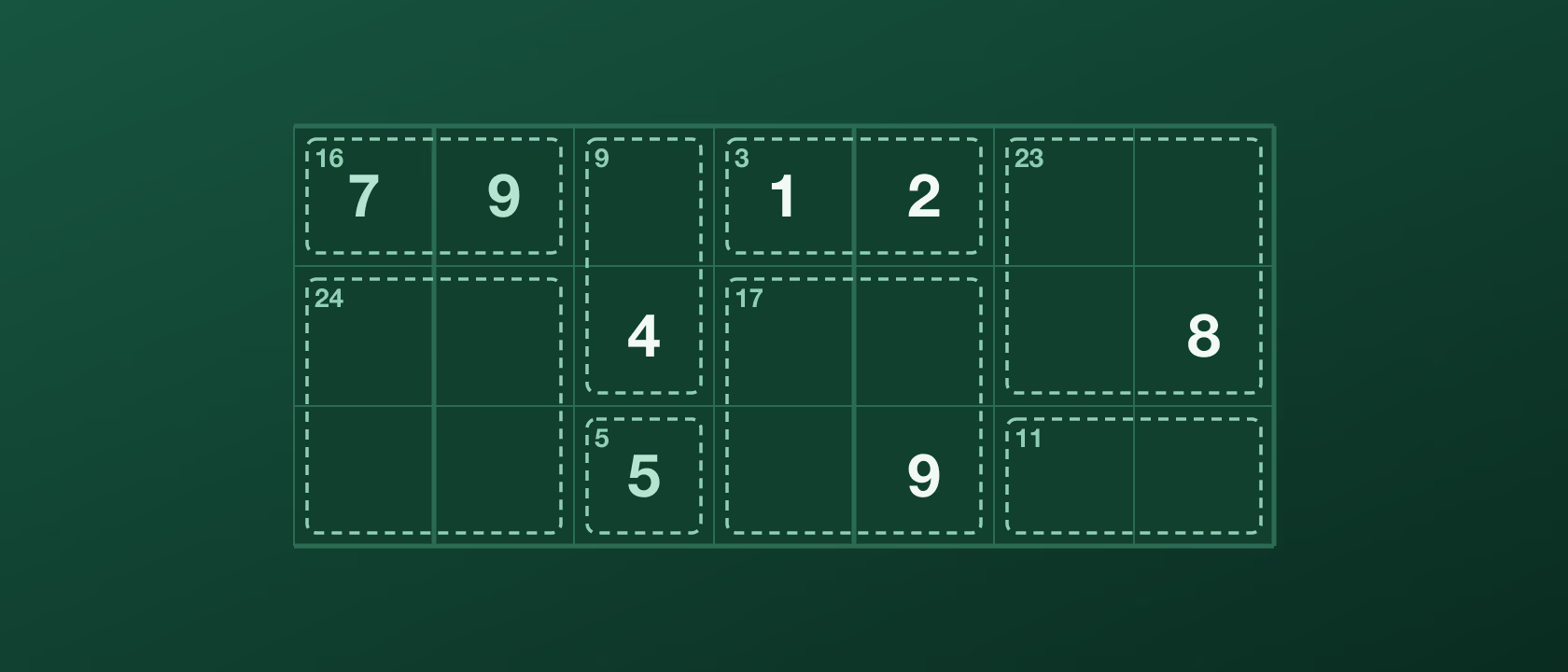
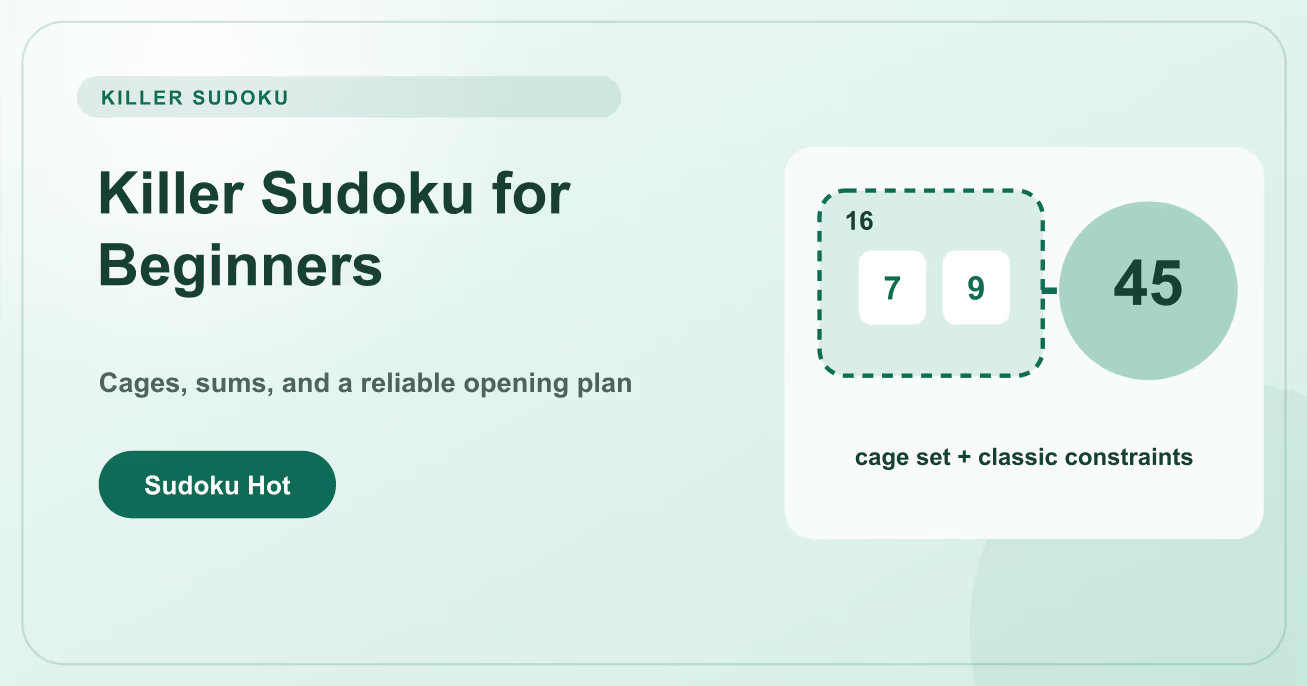
A two-cell cage totals 16. Repeated digits are forbidden, so 8+8 is illegal and the only combination is {7,9}. The cage crosses rows 3 and 4, and row 3 already contains a 9 outside the cage.
- Derive the cage set. List distinct two-digit combinations totaling 16. Only 7+9 survives because 8+8 repeats a digit inside the cage.
- Apply the row conflict. The cage cell in row 3 cannot be 9 because row 3 already has a placed 9. It must therefore contain 7.
- Finish the cage. The second cell must be 9 so that the two cells total 16. Check its column and box before committing the placement.
- Propagate both rule sets. Remove 7 and 9 from their classic peers, then inspect neighboring cages and the affected box for a new 45-rule subtraction.
Common beginner Killer mistakes
Repeating a digit inside a cage
Cage cells use distinct digits even when they sit in different rows or boxes. This immediately removes combinations such as 8+8 for a total of 16.
Treating a combination as ordered
A cage set tells you which digits are present, not which cell owns each digit. Use row, column, and box conflicts to determine the order.
Subtracting an incomplete boundary
The 45 rule fails when crossing cage cells are ignored. Draw the region mentally and account for every inside and outside cell before calculating.
Killer beginner checklist
- Memorize extreme cage sets before trying to memorize every possible sum.
- Write cage combinations as unordered sets and let classic constraints assign their positions.
- Use 45 only on a clearly counted row, column, or box; include crossing cells explicitly.
- After every placement, update the cage remainder and all classic peers in the same pass.
Beginner Killer Sudoku becomes manageable when you alternate two questions: “Which digit sets fit this cage?” and “Which positions survive the classic constraints?” Open Hell Mode at its first tier, mark the unique cages, and resist calculating large middle sums until the tighter regions have reduced them for you. Keep a small reference for extreme two- and three-cell sums during your first games; the combinations will become automatic through use, without turning the puzzle into a memorization test.
Killer Sudoku beginner FAQ
Do Killer Sudoku cages allow repeated digits?
No. Digits cannot repeat within one cage, even if the cells belong to different rows, columns, or boxes.
Why does every row, column, and box total 45?
Each contains digits 1 through 9 exactly once, and their sum is 45. This is the arithmetic basis of the 45 rule.
Should I memorize all cage combinations?
No. Begin with extreme sums and derive the middle combinations as needed. Repetition will make the useful sets familiar naturally.
Can I use normal Sudoku techniques in Killer mode?
Yes. Singles, pairs, Locked Candidates, and other classic techniques remain valid alongside the cage sum and no-repeat rules.
What if the board starts with no given digits?
Start from unique cage combinations and 45-rule regions. A well-constructed blank Killer grid supplies its opening information through cages rather than givens.