Sudoku Difficulty Levels Explained: Easy to Master
Sudoku difficulty is often explained by counting the given digits, but that shortcut is unreliable. A puzzle with many givens can still hide a demanding logical bottleneck, while a sparse-looking grid may unfold through straightforward singles. A useful difficulty label describes the hardest technique required, how often progress becomes hidden, and how much candidate bookkeeping the solve demands. Understanding those factors helps you choose a level that challenges rather than frustrates you.
Difficulty is not how empty the grid looks; it is how deep the next justified move is buried.
What determines Sudoku difficulty?
A Sudoku rating should be based on its logical solve path. Important factors include the most advanced required technique, the number of times that technique is needed, how many candidate positions must be compared, and whether easy deductions are available between harder steps. The placement and symmetry of givens affect appearance but do not fully measure difficulty. Two puzzles with 28 givens can behave very differently: one may produce a chain of Hidden Singles, while another stalls until a Locked Candidate or X-Wing removes one crucial note.
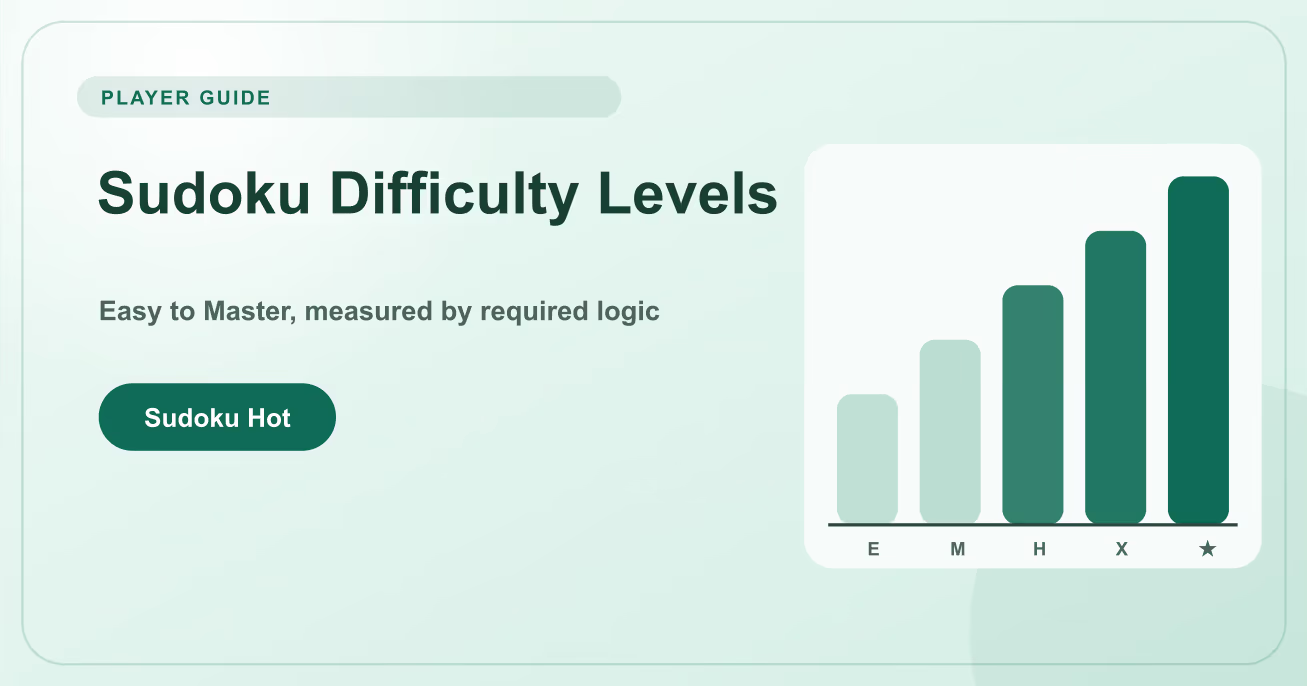
What to expect at each level
- Easy: scanning and singles. Most progress comes from cross-hatching, Naked Singles, and Hidden Singles. Candidate notes are optional, making this level ideal for learning the three basic constraints.
- Medium: candidate maintenance. Singles remain important, but pairs and simple box-line interactions begin to matter. Selective pencil marks help you see what basic scanning misses.
- Hard: subsets and locked positions. Expect Naked or Hidden Pairs, Locked Candidates, and longer gaps between placements. Complete, accurate notes become much more valuable.
- Expert: advanced eliminations. Patterns such as X-Wing or more complex subsets may be necessary. One elimination can require comparing candidates across several distant units.
- Master: sustained advanced logic. The puzzle may require multiple advanced deductions in sequence with few easy rewards. Accuracy, patience, and recovery from stale notes matter as much as pattern knowledge.
Example: why fewer givens do not always mean harder
Imagine Puzzle A starts with 32 givens and Puzzle B with 27. Puzzle A quickly reaches a position where no single remains and an X-Wing is required. Puzzle B has fewer clues but each placement reveals another Hidden Single. Puzzle A is logically harder even though its starting grid looks fuller.
- Compare required techniques. Puzzle A asks the solver to identify an aligned four-cell candidate pattern. Puzzle B asks for repeated one-position scans. The former requires a broader candidate model.
- Compare deduction depth. A single in Puzzle B immediately places a digit. The X-Wing in Puzzle A may only remove one candidate, after which another scan is needed to find the actual placement.
- Compare bookkeeping. Puzzle B can be solved with little notation. Puzzle A needs trustworthy candidate lists across multiple rows and columns; one stale note can hide or fake the pattern.
- Choose by comfort, not pride. If Hard produces useful effort and occasional breakthroughs, stay there. Move up when you can explain most deductions, not merely when you can finish by using hints or guesses.
Common difficulty misconceptions
Counting only the givens
Clue count affects appearance but not the full logical path. Position, interaction, and required techniques determine the real solving work.
Treating solve time as a universal rating
Experience changes speed. A technique you know may be invisible to another player, so time reflects both the grid and the solver.
Skipping levels too quickly
Finishing one puzzle with several hints does not mean the level is mastered. Consistent, explainable solves are a better signal for moving up.
How to choose your next level
- Choose a level where you can solve most of the grid logically but encounter one or two meaningful sticking points.
- After a hint, name the missed technique and try to find a second example before finishing the puzzle.
- Repeat a level until candidate updates feel reliable; advanced patterns are unsafe when the underlying notes are stale.
- Use Easy or Medium for speed and relaxation, and Hard or above for deliberate technique practice.
Use difficulty as a training selector, not a status badge. Easy and Medium build fluent scanning; Hard introduces the candidate interactions that make advanced solving possible; Expert and Master test whether those techniques remain accurate across a longer chain. Sudoku Hot keeps the levels distinct so you can choose a calm daily solve or a focused skills session without guessing what the label means.
Sudoku difficulty FAQ
What is the minimum number of givens in a valid Sudoku?
For standard 9×9 Sudoku with a unique solution, 17 givens is the known minimum. That fact does not mean every 17-given puzzle is harder than every puzzle with more clues.
Why do different apps rate the same puzzle differently?
Publishers use different solving engines, technique lists, and thresholds. Difficulty labels are useful within one system but are not universal measurements across every site.
Should beginners always start on Easy?
Usually yes, because Easy reinforces scanning and singles without demanding heavy notation. Move to Medium once the basic rules and candidate updates feel natural.
Does a symmetrical puzzle mean it is easier?
No. Symmetry usually describes how the givens are arranged for visual balance. It does not guarantee a simpler logical solve path.
Where does Killer Sudoku difficulty fit?
Killer Sudoku adds cage sums and no-repeat cage logic to classic constraints. Its rating also depends on cage combinations and arithmetic interactions, so it is not directly comparable to Classic by clue count alone.